

WORLD PREMIERE • BERLIN • Starting December 9, 2026
WORLD PREMIERE • BERLIN • Starting December 9, 2026
WORLD PREMIERE • BERLIN • Starting December 9, 2026
WORLD PREMIERE • BERLIN • Starting December 9, 2026
WORLD PREMIERE • BERLIN • Starting December 9, 2026
Starting December 9, 26
ARENA BERLIN
AGES 14 AND UP
GERMAN & ENGLISH
Starting December 9, 26
ARENA BERLIN
AGES 14 AND UP
DE & EN
WHERE FASCINATION AND THE ABYSS MEET.
True crime stories often focus on perpetrators—their names, their methods, and the myths surrounding them. CRIMINAL MINDS flips that perspective.
The exhibition ranges from case files and pieces of evidence to crime scene investigation, forensic science, and crime scenes, all the way to psychology, the victims’ perspective, and the question of how the media turns crimes into legends. Well-known cases such as those of Ted Bundy, Jeffrey Dahmer, and Fritz Honka are juxtaposed with stories that are virtually unknown outside their countries of origin. This is not a loose collection of crimes, but a cohesive narrative about violence, dehumanization, and our own fascination with evil.
40+
Documented Cases
1000+
Questions That Remain

Places of Violence
The centerpiece of the exhibition: a large, open showroom featuring walk-through crime scenes arranged side by side.

Two Perspectives
The audio guide presents the exhibition from two perspectives and offers two different ways to approach the cases.

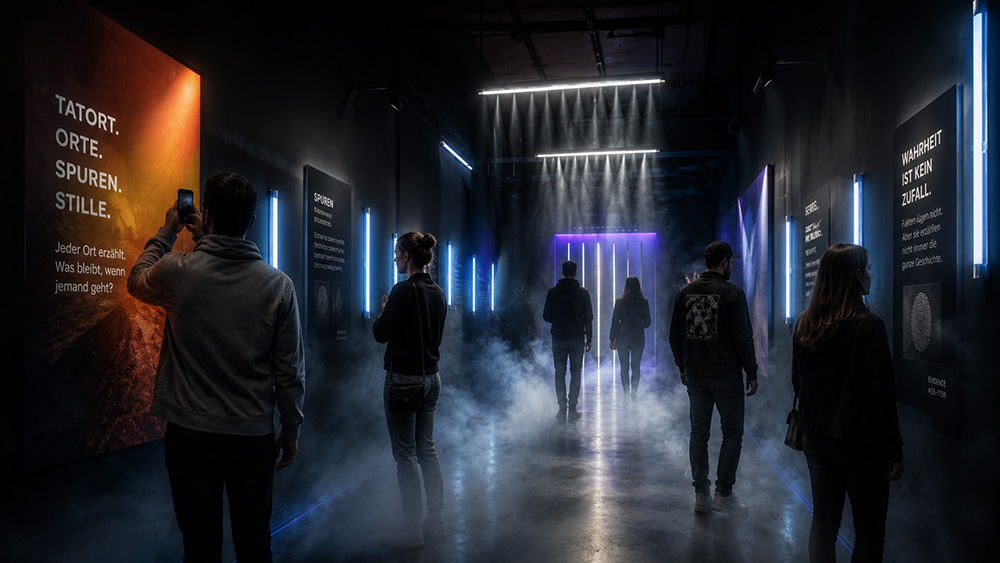
Bodies and Traces
The forest, the laboratory, and the forensic rooms demonstrate how even the tiniest traces of violence can be made visible and how perpetrator profiles can be identified.
Decision-Making and the Mind
Interactive pathways and a walk-through psychogram provide deeper insight into the perpetrators' motives, biographies, and decisions.
The Central Positioning
WE ASK: “WHO WAS THIS PERSON?”
CRIMINAL MINDS shows crime—but it doesn't stop there.
What does a clue reveal? How are suspect sketches created? How do forensic experts analyze a crime scene? What social conditions cause people to become invisible? And why do we often remember the names of the perpetrators better than the people they killed?
The exhibition deliberately navigates the balance between closeness and distance, analysis and emotion, fascination and reflection.
Listen. Watch. Discover
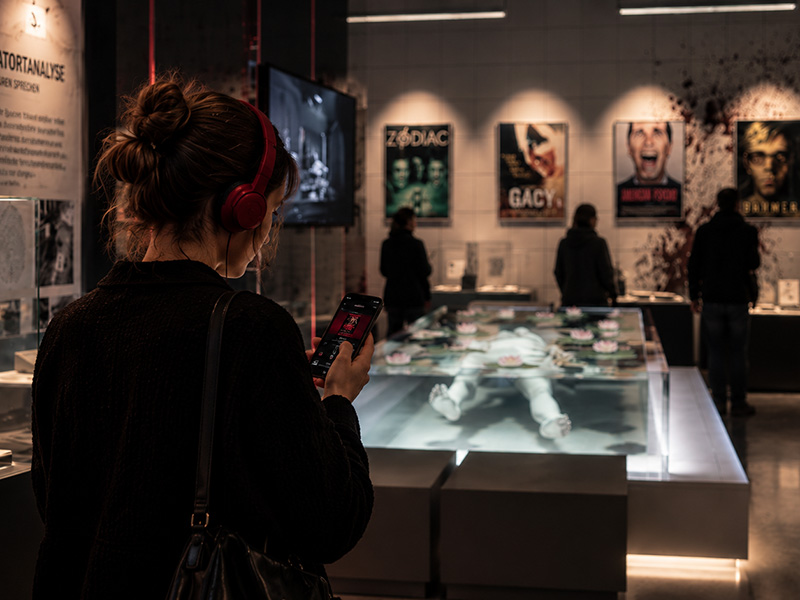
Audio guide included
Delve even deeper into the stories behind the crimes.
The audio guide takes you through the exhibition and offers fascinating insights into cases, background information, and different perspectives.